















Why Aerospace, Electronics, and More Are Turning to Laser Welders
If you’ve ever wondered how modern industries achieve precise, fast, and durable joints in complex products, the answer often lies in the laser welder. Unlike traditional welding, laser welding offers pinpoint accuracy, minimal heat distortion, and faster production speeds. These qualities make it a cornerstone of advanced manufacturing.
The global laser welding market is projected to grow steadily into the 2030s, driven by the demand for lightweight materials, miniaturization of devices, and automated production lines. From automobiles to medical implants, industries are investing in laser welding technologies to stay competitive in a fast-paced, innovation-driven economy.
Automotive Industry
Lightweighting & Fuel Efficiency
Automakers are under constant pressure to reduce vehicle weight to improve fuel efficiency and extend the range of electric vehicles (EVs). A laser welder allows manufacturers to join aluminum, high-strength steels, and composite materials seamlessly—without compromising strength. This is particularly crucial for EV battery packs, motor components, and battery tab connections where precision and reliability are non-negotiable.
High-Volume Production & Seam Welding
In automotive plants, speed is everything. Laser welders, integrated with robotic arms, streamline seam welding for car bodies, enabling faster production with fewer defects. The precision of the process also reduces the need for post-weld finishing, saving both time and costs while maintaining high safety and quality standards.
Aerospace & Defense
Critical Components & Structural Integrity
In aerospace, welding errors are not an option. Components like turbine blades, fuel tanks, and airframes must endure extreme conditions while maintaining structural integrity. Deep-penetration capabilities of a laser welder allow for robust joints in thick, high-strength materials that are resistant to fatigue.
Lightweight Materials & Reliability
Aircraft manufacturers increasingly rely on lightweight materials to cut fuel consumption. Laser welding enables these materials to be joined without the distortions often caused by traditional methods. Meeting strict regulatory standards, the process ensures unmatched reliability for mission-critical applications in both defense and commercial aviation.
Electronics & Microtechnology
Miniaturization & Micro-Welding
With the push toward smaller, more efficient devices, traditional welding methods fall short. A laser welder makes it possible to join delicate components on circuit boards, sensors, and connectors with minimal heat impact. This ensures that sensitive electronics function reliably without damage.
Wearables, IoT, Devices & Connectors
The demand for wearables and IoT devices has skyrocketed. These products often involve welding thin foils, copper, and aluminum in tiny spaces. Laser welders excel in such environments, delivering clean, strong welds where traditional tools cannot. This makes them indispensable in consumer electronics production.
Medical & Biomedical Devices
Precision & Biocompatibility
Medical devices require precision not just for functionality, but also for patient safety. Laser welding creates smooth, contamination-free welds on implants, surgical instruments, and diagnostic equipment. Its compatibility with sterile, cleanroom environments makes it a standard for the biomedical sector.
Micro-Assemblies & Miniature Components
From pacemakers to tiny surgical sensors, medical technology depends on welding extremely small parts. A laser welder provides the micro-scale accuracy needed for such assemblies, ensuring durability and reliability inside the human body.
Other Growing Sectors
Renewable Energy & New Energy Vehicles
Laser welding is vital for assembling batteries, solar-panel frames, and hydrogen storage systems. The energy sector relies on its precision and efficiency to build infrastructure that supports the global transition to renewable energy.
Jewelry, Consumer Goods & Fashion
The jewelry and fashion industry also benefits from laser welding, using it to join precious metals or decorative components where aesthetics and strength must go hand in hand.
Industrial Machinery & Metal Fabrication
Heavy machinery manufacturers use laser welders for molds, dies, and structural components, ensuring that large-scale equipment maintains both durability and accuracy under intense use.
Key Technological Drivers & Challenges
Fiber Lasers, Automation & IoT Integration
The shift toward fiber lasers is revolutionizing welding with higher efficiency, lower maintenance, and improved precision. Many modern welders now feature IoT integration, enabling real-time monitoring and AI-driven quality control to reduce defects.
Market Growth, Regulations & Standards
By 2035, the global laser welding market is forecasted to reach record highs, supported by stricter quality standards, environmental protocols, and the growing adoption of automation across industries.
Barriers: Cost, Skills, Material Challenges
Despite these advantages, challenges remain. High upfront costs for laser welding equipment, maintenance expenses, and a shortage of skilled operators can limit adoption. Continuous training and skill development are essential to bridge this gap.
How A Laser Welder Fits Industry Needs
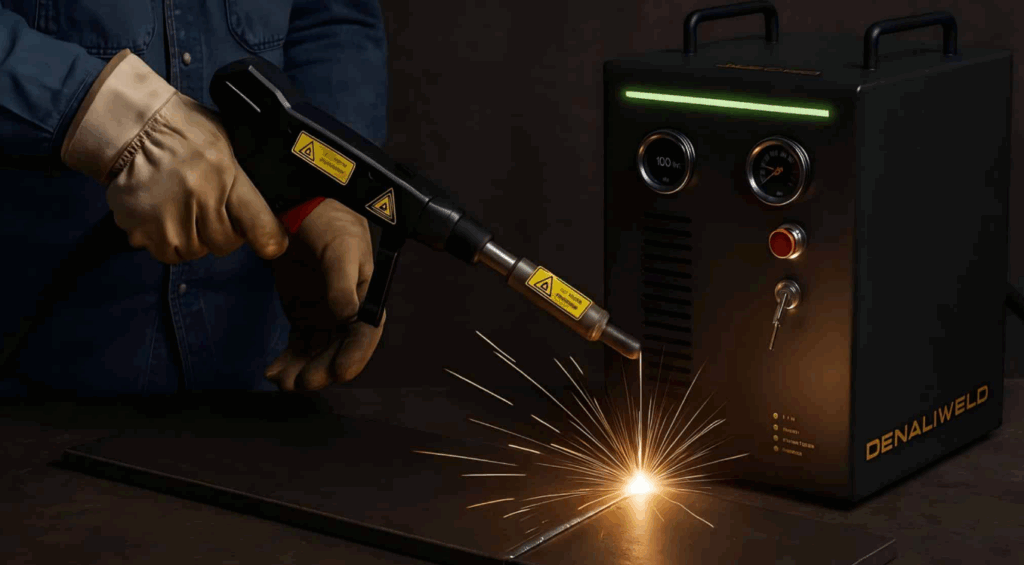
When industries require a balance of precision, speed, and safety, laser welder solutions from Denaliweld deliver measurable value. Designed for versatility, these products serve multiple industries, from high-volume automotive manufacturing to the delicate requirements of electronics and medical devices.
By integrating automation and fiber laser technology, these laser welders offer:
- High-throughput seam welding for automotive and aerospace applications.
- Micro-welding precision for electronics and biomedical components.
- Robust, energy-efficient designs that meet strict industry standards.
This adaptability allows manufacturers to optimize production while ensuring consistent quality, safety, and efficiency across diverse applications.
Conclusion
Across industries—from aerospace and automotive to electronics and healthcare—the laser welder has emerged as a vital tool shaping the future of manufacturing. Its unique combination of speed, precision, and reliability is enabling industries to meet the challenges of innovation, sustainability, and global competition.
As technology continues to advance, different companies are equipping manufacturers with the tools they need to scale production, reduce waste, and unlock new design possibilities. In the decade ahead, the role of laser welders will expand even further, cementing their place at the heart of modern industry.