















The Qualcomm Snapdragon 8 Gen 5 deep dive: Oryon and Adreno SoC brings performance to mobile

Snapdragon 8 Gen 5 is Qualcomm doing something refreshingly straightforward: take the same architectural direction as its top-tier silicon, then turn the knobs down until it fits the real world. Not the keynote world. The thin phone world, where most of the day lives between roughly 3W and 6W, and where the thermal budget is decided by glass, glue, and whether the vapour chamber was an afterthought.
Qualcomm will discuss percentage uplifts for CPU and AI, as that is what the market expects. The part worth paying attention to is the segmentation itself. What got cut, what stayed intact, and what those choices imply once an OEM ships a device that has to sustain performance rather than win 30 seconds of graphs.
Snapdragon 8 Gen 5 is positioned as a near-flagship platform for 2026 volume devices. It maintains the “custom everywhere” direction, including Oryon CPU cores, an Adreno 840-class GPU, a modern Hexagon NPU, and the current Spectra imaging pipeline. The split between the Elite and non-Elite tiers is not a new design. It is binning and narrowing.
The segmentation is the story.
At a high level, the recipe is simple:
- Keep the same CPU cluster layout and core family
- Keep the same GPU generation, but reduce the width
- Keep the same NPU generation and toolchain, but cap throughput
- Keep the same imaging direction
- Pair it with a slightly lower-tier modem
That is important because it changes how this tier behaves in practice. This is not a “last year’s flagship wearing a new hat.” It is the same plumbing with different operating points.
From Qualcomm’s perspective, it is a cost-and-risk play. Amortise the architecture across multiple SKUs, then let packaging, clocks, and active units do the product ladder. From an OEM and developer perspective, it is stability. One CPU family across tiers. One GPU family across tiers. One NPU stack across tiers.
For users, it should mean fewer “this phone is weird” edge cases. The experience is primarily degraded by performance limits, not by feature breakage.

Process node realities, and why clocks are not free
Snapdragon 8 Gen 5 is built on a TSMC 3nm class node. Public coverage points at N3P, but the practical point is consistent either way: this is a modern smartphone node where density and efficiency are good enough that the limiting factor is not “can you fit it,” it is “can you cool it.”
The basic physics has not changed:
- Dynamic power still scales roughly with capacitance, voltage squared, and frequency
- Leakage and idle behaviour matter more each year as the platform has more always-on blocks
- The phone’s chassis remains a small passive heatsink, and users still notice when it gets hot
Qualcomm uses node headroom to widen and modernise compute blocks, then relies on DVFS and thermal policy to control behaviour. Elite leans harder into headline clocks. Gen 5 backs off, and that is likely the more honest choice for phones that are not built like gaming bricks.
Oryon CPU: the big change is that there are no “little” cores anymore
Gen 5 keeps an eight-core Oryon layout:
- 2 prime cores at around 3.8GHz
- 6 performance cores at around 3.3GHz
The bigger point is not the exact MHz. Qualcomm has moved away from the classic Android mix of one very big core, a few mid cores, and a cluster of small efficiency cores. With Oryon, Qualcomm is effectively saying: we will run a set of high-capability cores across two performance bins, then manage efficiency through microarchitectural power control and scheduling rather than through a separate tiny-core type.
That changes behaviour under load. Instead of a single “go fast” island and a background cluster, you get eight cores that can all do real work without falling apart on latency-heavy tasks. The prime pair can stretch further for bursts, but the six are not there just to sip power and handle notifications.
In Elite, the prime pair is tuned harder for burst performance. In Gen 5, the primes sit closer to the six. That should reduce cases where the scheduler has to push a single core into a high-voltage corner to keep the UI responsive.
What we can infer about the microarchitecture
Qualcomm is not going to ship a clean pipeline diagram at a consumer launch. But Oryon does not behave like a small mobile core pretending to be big. The reasonable inference, based on what Qualcomm has shown across the wider Oryon family, looks like this:
- A wide front end that can fetch and decode multiple instructions per cycle
- A serious branch prediction setup to keep the machine fed across messy app code
- A deep out-of-order engine with enough buffers to hide cache misses
- Multiple integer and vector execution resources to keep throughput high on mixed workloads
- A strong load-store path and prefetch strategy, because mobile workloads are a soup of streaming bursts and random accesses
That is the point of a custom CPU. Qualcomm is investing die area and validation to build a core that targets its own efficiency curves and workload mix, rather than inheriting Arm trade-offs.
Qualcomm is also leaning into the idea that the CPU should handle small matrix work efficiently. Not because the CPU replaces the NPU, but because real pipelines contain a lot of “glue” work that is not purely GEMM.
Think about common on-device AI and imaging flows:
- Pre and post-processing around models
- Tokenisation and formatting for text pipelines
- Control flow and UI work around inference
- Small transforms that are too tiny to justify waking the NPU
If the CPU can handle those steps efficiently, the platform bounces between blocks less often, flushes caches less often, and wastes less power on coordination overhead.
Cache hierarchy and coherence: the part Qualcomm never markets properly
The best smartphone SoCs behave well because data moves efficiently. That is usually less about peak DRAM bandwidth and more about cache hierarchy, coherency, and the fabric tying everything together.
Qualcomm does not publicly enumerate every cache size for Gen 5, but the broad shape is predictable:
- Private L1 caches per core
- Substantial L2 capacity close to the cores
- A shared L3 or system cache pool feeding into a coherent interconnect
The coherence fabric matters because it reduces pointless copying:
- CPU can prepare tensors and hand them off to the NPU without excessive memory churn
- ISP can write intermediate buffers that the GPU consumes without a DRAM round trip
- Accelerators can share working sets under controlled policies rather than constantly accessing DRAM
In a phone power envelope, every avoided DRAM transaction is effectively a battery life gain.
Adreno 840: two slices, not three, and that is the right cut
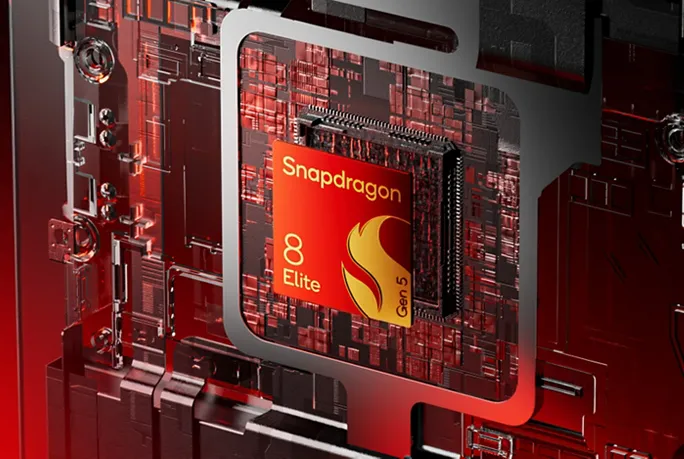
On the GPU side, Gen 5 retains an Adreno 840-class architecture but in a narrower configuration. Elite uses three slices. Gen 5 is expected to ship with two.
A “slice” here is not a single compute unit. It is a portion of the GPU that includes shader resources, fixed-function blocks, caches, and the logic needed to maintain workflow. Cutting a slice is a real reduction in peak throughput.
But in phones, peak throughput is often a fantasy number. Thermals and sustained power limits decide what you can hold for minutes, not what you can spike for a benchmark run. A two-slice GPU that can sit at a decent efficiency point for longer is often better than a three-slice GPU that throttles into a worse sustained plateau.
Scheduling, utilisation, and why fewer slices can be saner
Adreno scheduling has historically been about issuing waves of work and hiding memory latency through parallelism. With fewer slices, each slice sees a more consistent load under heavy use, which can make it easier to keep the GPU in a stable utilisation regime.
It also reduces the temptation to build a phone that is effectively a space heater during gaming. If the worst-case peak is lower, the OEM has a better chance of tuning to a stable sustained level without violent throttling.
Frame generation and upscaling are doing more of the heavy lifting now
The more interesting part of modern mobile GPUs is not raw shader counts. It is all the machinery that tries to improve perceived performance without paying the full cost every frame.
Qualcomm’s frame motion and upscaling logic exists to do two things:
- Reduce render costs while maintaining smooth display output
- Mask frame time spikes to reduce stutters
On a narrower GPU, those features matter more, not less. If the platform can render at lower internal cost then reconstruct, it saves power and heat. This is also an area where dedicated helpers and good driver paths can beat brute force.
Ray tracing remains a sprinkle, not the meal. Gen 5 keeps hardware ray tracing support, but narrowing the GPU makes the cost more obvious. On mobile, ray tracing is still best treated as a selective effect, not a full-scene commitment.
Hexagon NPU: same generation, trimmed peak, same software stack
Qualcomm’s Hexagon NPU is not a single block. It is a collection of vector, tensor, and scalar resources with local memory and DMA machinery to keep data moving.
Gen 5 sits in the same generation as Elite but has lower peak throughput. That can be achieved through fewer active units, lower clocks, or tighter power limits. The key point is that the NPU ISA and the software stack remain consistent across tiers.
That matters for developers. No one wants separate AI code paths for each Snapdragon tier. If the same operator libraries and kernels scale across Elite and Gen 5, then segmentation becomes a performance knob, not a compatibility headache.
On-device LLMs: what changes in the real world
The marketing fantasy is “run huge models locally.” In practice, most phone AI use cases do not require large context windows or high token rates. A voice assistant responding to a short command or a summariser processing notifications does not require the largest possible model running at peak capacity.
Gen 5 should be able to run similar model classes as Elite with more aggressive quantisation, lower throughput, or reduced context. That is the tradeoff, intended to ship in volume without forcing exotic cooling.
CPU plus NPU cooperation is where the platform lives or dies
Most mobile AI workloads are pipelines, not pure inference:
- ISP, GPU, or CPU prepares data
- CPU calls into the runtime, which schedules operators and allocates buffers
- NPU runs the heavy kernels, leaning on local SRAM and DMA to avoid DRAM stalls
- CPU formats results and feeds them back to the app
From a power perspective, the goal is to keep the NPU busy when it is the right tool, and let the CPU spend as much time as possible asleep between coordination steps. That is where node improvements, fabric design, and scheduling policy interact.
Spectra ISP: the architecture is about parallelism and data movement
Gen 5 follows the same general imaging direction as Elite, including a triple-pipeline design with high per-channel bit depth. Modern camera systems are multi-sensor, multi-stream, and latency-sensitive.
A triple pipeline lets the platform ingest and process multiple sensors without serialising everything into a single queue. That helps with:
- wide plus ultra wide for seamless zoom transitions
- wide plus tele for portrait and depth effects
- rear plus front for picture-in-picture and creator modes
AI is woven through the pipeline, but the architectural constraint is not the feature list. It is the cost of moving intermediate buffers around. If the fabric and memory policies are solid, you can run segmentation, denoising, depth estimation, and super-resolution without blowing the power budget on copies.
On video, the interesting question is not which codec box gets ticked. It is whether the pipeline can handle multiple streams, overlays, and real-time filtering without hitting a thermal cliff or saturating storage writes.
Memory subsystem: the bandwidth number matters less than how it is used
On paper, Gen 5 supports LPDDR5X via a 64-bit interface. High-end pairings at around 9.6 Gbps per pin put aggregate bandwidth in the mid-70 GB/s range.
The nuance is how the platform allocates that bandwidth:
- CPU relies heavily on caches and prefetching rather than sustained DRAM pressure
- GPU bandwidth bursts in games, but thermals limit sustained gaming throughput
- NPU workloads can be memory-bound, but local SRAM pools reduce DRAM trips
- ISP and video encode are predictable streaming patterns DRAM controllers handle efficiently
A well-balanced SoC is designed for realistic mixed workloads, not the pathological synthetic case where every accelerator hammers DRAM simultaneously.
The NoC: the hidden constraint that decides “smooth” versus “stutter”
The network-on-chip ties together the CPU cluster, GPU slices, NPU, ISP, display, modem, and memory controllers. Qualcomm does not publish a full map, but the design rules are consistent:
- Hierarchical fabrics so local clusters do not always fight on a single global path
- Quality-of-service mechanisms so display and UI do not hitch when background tasks get noisy
- Separate clock and power domains so blocks can sleep without dragging the whole system awake
Gen 5 inherits the Elite-era fabric. With lower clocks and fewer GPU slices, it should perform well in real-world scenarios, assuming OEMs do not sabotage it with weak memory configurations.
Modem tiering: X80 is “lower”, but mainly on paper
Gen 5 pairs with the Snapdragon X80 modem rather than the top tier. In practice, this is the kind of segmentation most people will never measure.
The real value is efficiency and integration: how the modem holds a connection without burning power, how tightly it coordinates with platform power management, and whether data movement from baseband buffers into application memory is clean.
In smartphones, antenna layout and board design often decide more than the modem tier. Some OEMs build good RF. Some do not. The SoC can only do so much.
Thermals: the only benchmark that matters is real word use
Everything above is architecture. The user experience is thermal.
In a thin phone, performance falls into three regimes:
- Idle and background: sensing, radio, and low clocks keep the device responsive at a few hundred milliwatts
- Burst: quick spikes for UI, short camera tasks, and momentary load
- Sustained: minutes of gaming, navigation, long recording, or heavy multitasking
Gen 5 is designed to perform well in the first two, and to accept that the third must live within chassis limits. Reducing GPU width and lowering clocks reduces the worst-case thermal peak. That makes it easier to land on a stable sustained plateau rather than repeatedly smashing into a ceiling.
Where that plateau sits depends on the phone, not the chip. A thicker device with a serious vapour chamber will run closer to the theoretical curve. A thin fashion phone will not. Silicon offers options. It does not violate physics.
Where Snapdragon 8 Gen 5 actually lands in devices
Strip away branding, and it looks like this:
- Eight custom Oryon cores in a 2 plus 6 layout with sane clocks and coherent cache hierarchy
- An Adreno 840-class GPU in a two-slice configuration tuned for efficiency, not peak
- A Hexagon NPU in the same generation as the top-tier part with the same software stack and a lower ceiling
- A modern Spectra imaging pipeline built for multi-sensor, AI-assisted photography and video
- A 3nm class process intended to keep the platform inside a realistic smartphone power envelope
The compromises are clear. It does not ship the full brute-force configuration of Elite. Some headline features sit one notch down. It will lose synthetic shootouts if you ignore sustained behaviour.
But that is the point. This should be a “not quite top-tier” Snapdragon that is architecturally honest. Same direction, trimmed to fit reality. If you care more about sustained performance, battery life, and consistent behaviour than winning a chart for 30 seconds, that is the trade you actually want in a mass-market premium phone.