











From Page to Play: The Best Books That Became Video Games
Stories move. They jump from campfires to scrolls, from scrolls to paperbacks, and now — from paperbacks to game controllers. The relationship between literature and gaming is older than most people think. And it keeps growing.
Why Books Make Great Games
When reading novels online, readers become familiar with the entire world: characters, rules, history, tension. It’s logical that when you read a book, be it The Witcher or Forbidden Heat, you’ll get the maximum amount of detail. And FictionMe is always on hand for that. Game developers also love that. Building a universe from scratch takes years; borrowing one from a beloved story cuts the work in half—and brings a ready audience with it.
According to a 2023 report by Newzoo, the global video game market surpassed $184 billion. Publishers are always hunting for source material that resonates. Books that became video games are not a niche curiosity anymore. They are a business strategy.
The Witcher: Poland’s Greatest Export
Andrzej Sapkowski wrote the first Witcher short story in 1986 for a Polish fantasy magazine. Nobody predicted what would happen next. CD Projekt Red adapted the saga into a game trilogy, and The Witcher 3: Wild Hunt went on to sell over 50 million copies worldwide.
Sapkowski himself was famously skeptical of the games at first. He sold the rights for a flat fee. He later admitted that was a mistake — and the irony is that the games drove millions of readers back to his novels. The books and the games made each other bigger.
Metro: From Moscow’s Tunnels to Your Screen
Dmitry Glukhovsky published Metro 2033 online for free in 2002. Readers passed it around. Word spread. By the time it reached print, it had already built a cult following across Russia and Eastern Europe.
4A Games turned it into a shooter in 2010. The atmosphere was suffocating, dark, and brilliant. Two sequels followed. Glukhovsky stayed involved throughout, writing the game narratives himself — a rare example of an author who never lost control of his own story.
American McGee’s Alice — A Twisted Case
This one works differently. Alice’s Adventures in Wonderland by Lewis Carroll is, of course, a classic. Public domain. Free to use. American McGee took that freedom and twisted it into something deeply strange in 2000.
Carroll wrote whimsy. McGee wrote horror. The game reimagined Alice as a traumatized girl using the logic of Wonderland as a coping mechanism. It found a devoted fanbase. A sequel arrived in 2011. The lesson? Sometimes the best adaptation is a radical reinterpretation.
Dune: The Book That Shaped Gaming More Than Any Other
Frank Herbert published Dune in 1965. It invented the template for epic world-building. Many game designers have cited it as a foundational influence — but the direct adaptation came in 1992 with Dune II from Westwood Studios.
Dune II essentially created the real-time strategy genre. Command & Conquer, StarCraft, Age of Empires — all of them trace their DNA back to this single game. Herbert’s sand planet didn’t just inspire novels. It quietly shaped how an entire category of games works.
What Made Dune Work as a Game?
The resource system. Spice in the novel is the most valuable substance in the universe — everything revolves around controlling it. That concept translated perfectly into RTS mechanics. One powerful idea from a book became the backbone of a billion-dollar genre.
S.T.A.L.K.E.R. and the Strugatsky Brothers
Roadside Picnic by Arkady and Boris Strugatsky, published in 1972, is a short novel about an alien visitation that leaves behind a zone of deadly, incomprehensible phenomena. GSC Game World built S.T.A.L.K.E.R.: Shadow of Chernobyl on that foundation in 2007.
The game moved the setting to Chernobyl’s exclusion zone, blending Soviet tragedy with science fiction dread. It sold over 4 million copies. A sequel, S.T.A.L.K.E.R. 2: Heart of Chornwall, launched in late 2024 — and reached 1 million sales within its first few days on Steam.
I Am Legend and the Zombie Genre
Richard Matheson’s 1954 novel I Am Legend is technically about vampires. But its structure — one survivor, a world overrun by infected former humans, the slow erosion of hope — became the blueprint for nearly every zombie game ever made.
The Last of Us, arguably the greatest narrative game of the 2010s, owes an enormous debt to Matheson. Developer Neil Druckmann has confirmed the influence. The novel never became a direct game adaptation. But its shadow falls over an entire genre.
Novels Inspired by Video Games — The Reverse Flow
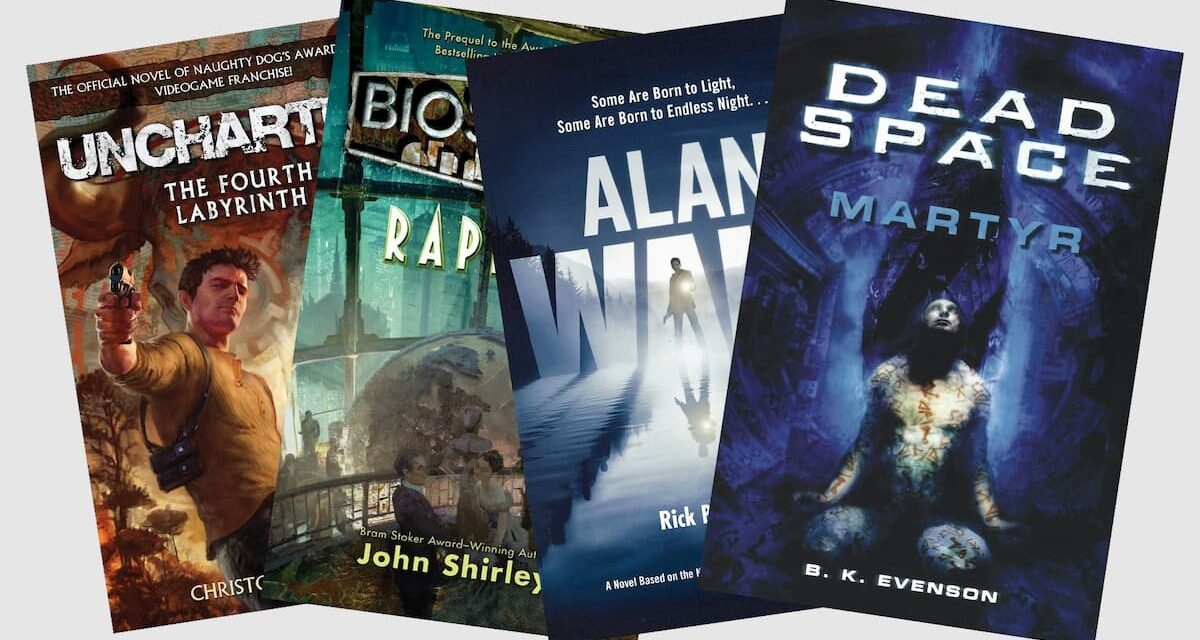
This is where things get interesting. The traffic is moving in both directions. Novels inspired by video games now fill entire shelves, and entire sections are appearing on online platforms. Just install the app now, and you’ll see many familiar titles from video games. The Halo universe has dozens of tie-in novels. The Assassin’s Creed book series is massive. Ready Player One by Ernest Cline — itself a novel deeply shaped by gaming culture — became a Spielberg film and spawned its own game adaptations.
The line between source and adaptation has blurred completely. A game spawns a book. The book inspires a new game. The franchise loops forever. Readers who are also players no longer have to choose which version they prefer.
Why This Trend Will Only Accelerate
Game budgets now rival Hollywood productions. The demand for rich, pre-built worlds has never been higher. At the same time, publishers are realizing that games can do something films cannot — they can let you live inside a story for 60 hours, not just watch it for two.
Books offer depth. Games offer immersion. When the right novel meets the right studio, something genuinely extraordinary happens. The page doesn’t disappear — it becomes the foundation for something larger. That is the real magic of this relationship. And it is only just beginning.