












How Custom Lithium Polymer Batteries Solve Space Constraints in Modern IoT Devices
How Custom Lithium Polymer Battery Design Drives Success in Space-Constrained IoT Hardware
Learn how custom lithium batteries help IoT developers overcome space limitations, extend runtime, and simplify hardware design through optimized battery geometry and protection circuits.
Designing a compact IoT device is often a balancing act. Engineers optimize PCB layouts, reduce component count, improve antenna performance, and fine-tune firmware to save every possible millimeter inside the enclosure.
Yet one component usually determines whether the design succeeds or needs another mechanical revision—the battery.
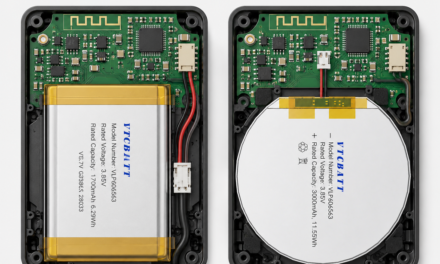
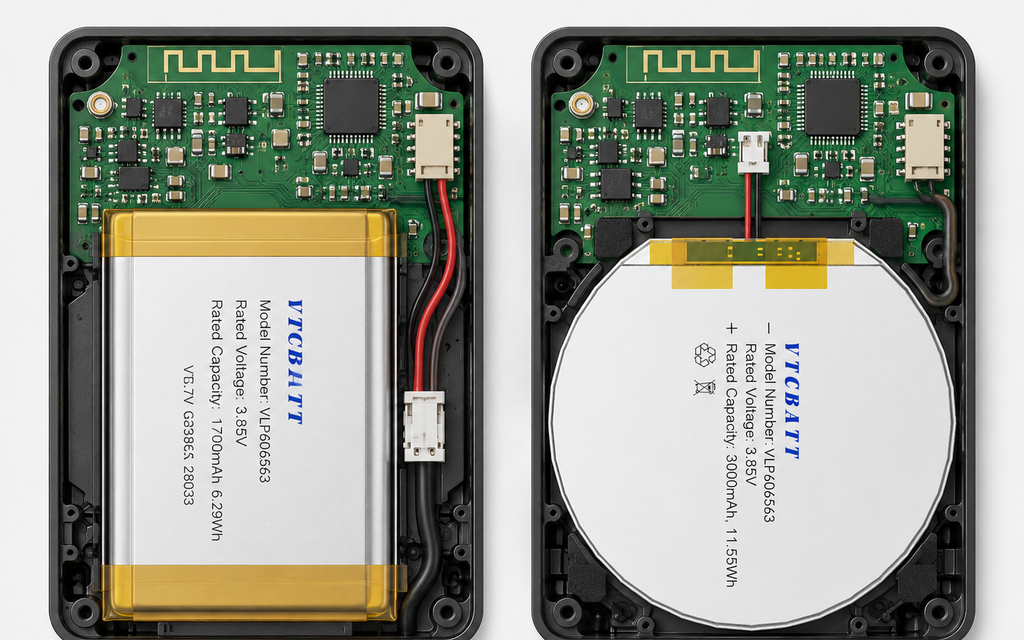
Many IoT products still rely on standard lithium polymer cells available in fixed sizes. While these batteries are easy to source, they rarely make full use of the available space inside the product. For devices with curved housings, ultra-thin profiles, or irregular internal layouts, a standard battery can leave valuable volume unused.
As hardware becomes smaller and smarter, more manufacturers are choosing custom lithium polymer batteries designed specifically for the product instead of forcing the product to fit the battery.
Why Standard Batteries Don’t Always Fit
Modern embedded systems have become remarkably compact.
A wireless module, microcontroller, sensors, and power management ICs can now occupy only a small portion of the PCB. Components such as the ESP32-S3, Nordic nRF52 series, and STM32 MCUs provide powerful wireless connectivity while requiring very little board space.
The battery, however, has not become proportionally smaller.
In many projects, the battery remains the largest component inside the enclosure. When engineers choose an off-the-shelf cell, they often have to accept compromises such as:
- Empty space inside the housing
- Increased product thickness
- Shorter operating time
- Mechanical redesigns late in development
A battery that fits the enclosure instead of the catalog often provides a much better overall solution.
Suggested Figure 1: Standard pouch battery vs. custom-shaped battery inside the same enclosure
When Does a Custom LiPo Battery Make Sense?
Not every product requires a custom battery. For many consumer electronics, standard cells work perfectly well.
Custom batteries become valuable when internal space is limited or the enclosure cannot be changed.
Typical examples include:
- GPS asset trackers
- Wearable medical devices
- Smart locks
- Barcode scanners
- Industrial IoT sensors
- Portable diagnostic equipment
- Smart glasses
- Compact handheld electronics
In these applications, even a few extra millimeters of usable battery volume can noticeably increase runtime without increasing the overall product size.
Battery Shape Can Be Just as Important as Capacity
Engineering Note: During OEM projects, battery dimensions are usually finalized after the PCB and enclosure are defined. At this stage, the available battery compartment may already be restricted by antennas, sensors, mounting posts, connectors, and structural supports.
When engineers think about batteries, capacity is usually the first specification they compare.
In practice, battery geometry is often just as important.
Instead of selecting a standard rectangular cell, manufacturers can customize parameters such as:
- Length
- Width
- Thickness
- Tab position
- Cable direction
- Connector type
Some products even require L-shaped, curved, stepped, or triangular batteries to match the available space.
In a recent optimization project involving a compact LTE asset tracker with less than 7 mm of available internal height, redesigning the battery dimensions rather than modifying the enclosure allowed the engineering team to increase battery capacity by nearly 20% while maintaining the same product size
This type of optimization is difficult to achieve using standard batteries alone.
The Battery Is Only Half of the Design
A reliable battery pack is more than the lithium cell itself.
The protection circuit plays an equally important role in long-term reliability.
Depending on the application, engineers may integrate:
- PCM or BMS
- NTC temperature sensor
- Resettable fuse (PTC)
- Custom wire harness
- Low-profile connectors
- Fuel gauge IC
- Communication interfaces such as SMBus, CAN, or I²C
A single-cell IoT battery assembly may use a compact PCM or protection circuit, while multi-cell or function-rich packs may require a more capable BMS. Designing these components together with the battery helps simplify assembly and improves consistency during mass production.
Instead of adapting the protection board after the battery is selected, many OEM manufacturers now develop both together from the beginning of the project.
Preventing Deep Discharge in Low-Power IoT Devices
Many IoT products spend most of their life in standby mode.
Although the operating current may be only a few microamps, the battery continues to discharge over months of storage and deployment.
If the voltage drops too low, permanent capacity loss may occur.
For this reason, many battery packs include hardware undervoltage protection that disconnects the load before the cell enters an unsafe discharge region. In single-cell lithium polymer batteries, the host device should normally shut down before the cell reaches its minimum permitted discharge voltage. The hardware protection circuit provides a secondary cutoff, but its exact threshold depends on the cell specification and selected protection IC. Engineers should not use the protection cutoff as the device’s normal operating endpoint.
Engineers should also pay attention to the standby current of the protection circuit itself. A low-quiescent-current protection circuit helps reduce parasitic drain during long-term storage.
Engineers should review the cell specification, the protection IC datasheet, the charger settings, and the host-system shutdown strategy together.
Involve Your Battery Supplier Earlier
One common mistake is selecting the battery after the mechanical design is already complete.
By that stage, available space is fixed, leaving very few options for optimization.
A more efficient workflow is to involve the battery supplier during the enclosure design phase.
Early collaboration allows both teams to optimize:
- Battery dimensions
- Connector location
- Wire length
- Protection circuit thickness
- Mechanical tolerances
- Certification requirements
Many redesigns can be avoided simply by considering the battery as part of the overall product architecture instead of treating it as a standard purchased component.
For engineers working on space-constrained embedded products, early battery customization often reduces development time while improving final product performance.
What Information Should Engineers Provide to a Battery Supplier?
Early supplier involvement is most effective when engineers can provide clear mechanical and electrical requirements. The starting point should be the maximum available battery length, width, and thickness. A 3D enclosure drawing is especially useful because mounting posts, PCB edges, antennas, connectors, and housing ribs may reduce the actual usable space.
The supplier should also understand the device’s average operating current, peak current, peak duration, and target runtime. These values help determine whether the proposed cell can support both normal operation and short high-power events such as wireless transmission, motor startup, display activation, or GPS positioning.
Charging requirements are equally important. Engineers should confirm the charging voltage, maximum charging current, charger IC, and available charging time. Operating and storage temperatures must also be defined, particularly for outdoor trackers, medical devices, and industrial sensors.
Other requirements may include the connector model, wire length and direction, PCM, NTC, PTC, fuel-gauge function, and communication interface. Finally, the supplier should know the target certification market, prototype quantity, expected annual demand, and planned production schedule. Providing this information early reduces the need for repeated revisions and helps the supplier evaluate whether a standard cell, a dimensionally customized cell, or a fully custom battery assembly is the most practical solution.
Conclusion
As IoT devices continue to become smaller and more capable, efficient use of internal space becomes increasingly important.
A custom lithium polymer battery is not simply a battery with different dimensions. When designed in concert with the mechanical structure and electronics, it can improve runtime, simplify assembly, reduce redesign effort, and enhance long-term reliability.
Power system design is no longer the final step of product development. For many modern embedded products, it has become an important part of the engineering process itself.